The Growing Sucralose Infestation
 Whatever happened to the good old days when you could glance quickly through the beverage aisle and tell the diet beverages from the good beverages? We’ve had such a great system for so long: if it says “diet” or “sugar free” it’s DIET, and if it doesn’t, it has some form of super tasty sugar derivative in it, whether it be cane sugar, high-fructose corn syrup, or something else awesome.
I used to be so good at telling the two drinks apart.
Lately, however, I’ve found myself repeatedly hoodwinked by the chemically synthesized impostor known as sucralose… or “Splenda”, its Christian name. The substance is 600 times sweeter than table sugar, and although it’s not as bad as saccharin, aspartame, or any other past cancer-powder, it’s still not sugar, and it still tastes like crap.
As such, I humbly request of beverage companies that you please quit trying to be sly about these DIET drinks and label them just as previous DIET drinks were labeled: with the letters D.I.E.T.
When I see those letters, I know that purchase of the beverage in question will result in palate-shriveling aftertaste and lack of drinking satisfaction. When I see those letters, I know to move right along.
Instead, however, these sucralose-tainted drinks often use small, subtle terms like “lower sugar”, “lower calorie”, and sometimes no marquee labeling at all. This is confusing as there are plenty of legitimate “lower sugar” drinks on the market that simply removed some of the sugar (see Paul Newman’s Lightly Sweetened Lemonade). Often times, you need to read the entire label to know the difference. And to make matters worse, a lot of these drinks contain sugar near the top of the ingredient list and sucralose near the end… so it’s not even sufficient to just “look for the sugar” anymore.

“Noni Berry” for metabolism and “Goji Punch” for immunity. Can you tell which one is the diet one?
To be clear, I have nothing against sucralose itself. It could very well be the best artificial sweetener ever invented. I just resent that marketers, by not clearly labeling it, have blurred the representation of what is and what isn’t a diet drink; and as a front-line soldier in the weekly quest to discover and sample new beverages, I’m just sick of getting hit by all this repackaged, remarketed diet shrapnel.
UPDATE: Literally the very nanosecond I pressed the Publish button just now, a Splenda television commercial came on. It’s everywhere.
Enterprise CMSes vs. Blog CMSes
True or false: Most major news organizations (e.g. The Washington Post, The Seattle Times, ESPN, etc) would be better off running their entire online publishing operations through a modified blogging platform (e.g. WordPress, Movable Type, Newsvine, or a home-grown solution) than through an enterprise CMS.
In other words, in five years, will mainstream news sites essentially be collections of individual writer blogs tied together mainly with section indexes and cross-linking?
Russ.

I was standing in the NBC Nightly News studio on a cold Thursday night last January when Brian Williams’ on-air guest sat down for a quick chat with Brian, and the rest of the country. It was Tim Russert, talking with his trademark animation about how the fate of country depended on the results of the upcoming Super Tuesday primaries.
I positioned myself by the swinging glass door such that I could intercept Russert as he left the set during the commercial break. Sure enough, a minute later, he came bounding towards me, smiling like a kid who’d just aced his final exam.
“Hi Mr. Russert. My name’s Mike. I run Newsvine.”, I said, stepping in front of him to shake his hand.
He scanned my face against the hundreds of thousands he’d seen before in his life, trying to decide if he should recognize me, and then raised his hand to meet mine.
“What an election!” he shouted with a big smile, and then continued through the studio at full speed.
That is one of my many lasting memories — and my only personal one — of Tim Russert, who died of a heart attack yesterday at age 58. He was a man who made politics an interesting subject to follow, even for someone like me who is generally put off by the subject. He was known as the most prepared, incisive interviewer in the business, and he will be missed. Best wishes to the Russert family, his closest friends, and everyone else affected by his passing.
Seeking Web Developer at Newsvine
 People often ask what things are like at Newsvine after the MSNBC acquisition. Specifically, has the culture changed at all and does it still feel like a startup? The answer to those questions are, thankfully *no* the culture hasn’t been disrupted a lot and thankfully *yes* it still feels like a startup (minus the working for 1929-level salaries).
One of the many nice things about life post-acquisition is that we’re beginning to work on many projects that touch both Newsvine.com (little ant of 1.5 million users) and MSNBC.com (big elephant of over 35 million users).
As such, we’re expanding a bit…
The Newsvine Team is looking for an experienced, self-motivated, and passionate front-end developer to join us in building products and services for the Newsvine platform. Your primary responsibility will be to design and develop site features and functionality in a multi-tier web environment using PHP, CSS, JavaScript, and the YUI JavaScript library. Additional responsibilities include daily site support and maintenance. The ideal candidate is able to work on small teams under tight deadlines with little supervision. A computer science degree or equivalent is a plus, but experience, skill, and attention to detail are more important.
The ideal candidate will have a strong command of the following knowledge areas:
- X/HTML, CSS, DOM, and JavaScript
- PHP or similar scripting language
- Mastery of web standards and cross-browser compatibility
Preferable Job Qualifications:
- Experience working on large-scale, high-availability web sites
- Successful industry experience using latest DHTML and ajax technologies
- Experience with SQL and relational database implementations serving as the backend to production web applications
- Experience with, or an interest in, working with the YUI JavaScript library
- Familiarity with Subversion a plus
The job will be based out of the lovely Newsvine offices in Seattle, down by the waterfront pictured here. If you’re interested, please send an e-mail and resumé to “newsvinejobs at newsvine.com”.
Paparazzi 2.0: Coolspotters Launches
 A few days ago, my ex-colleagues from ESPN.com launched a new site: Coolspotters.
It’s a soon-to-be gigantic database of public figures and the products they use. Want to see what watch Barack Obama wears? How about what jeans Steve Jobs wears? Or anything at all about Gisele Bundchen…
It’s all right there for your perusing pleasure, but even better, it’s 100% powered by the community (of course) so you can add photos and details if you happen to snap that candid shot of Anna Kournikova pulling up in her Escalade.
The site is interesting to me on many levels:
- Although I’m not generally interested in what public figures buy (although millions of people are), I’m very interested in the concept of how to express your consumer tastes on the web. I’m equal parts salesman, connector, and maven in the Gladwellian sense and product “endorsements” on the web have the ability to touch all three disciplines. Whoever successfully discovers how to get everyone to express their product endorsements on the web without seeming salesy is going to be a huge financial success.
- Coolspotters was created by a very talented group of friends who I’ve worked with for years and funded by the same people who funded us at Newsvine. In that sense, they are a sister company to us.
- The site has really fantastic click appeal. In other words, without registering or otherwise even “getting” the site, you can click around for hours (see previous words re: Bundchen and Kournikova). This is something I always wanted to do better at Newsvine; showcasing content that is a lot lighter on the brain and the attention span.
- The design, courtesy of Aaron Weyenberg and Mark Boulton, is of course fantastic.
So anyway, check out Coolspotters.com and let the fellas know what you think in the comments below.
Someone Predicted this Credit Mess Five Years Ago
Normally, I think of The Motley Fool as one of the most worthless financial sites around, spouting off attention-grabbing, sensationalist headlines just to pull readers into their abyss of mediocre financial articles. Here is a sampling of some typical headlines that have popped up over the past few weeks:
You get the picture.
However, today, a Motley columnist pointed to what may be the most prescient piece of content ever to appear on the site. Fittingly, it came from a reader on a discussion board and not an actual Motley Fool employee.
Here is the discussion board post. It’s quite amazing. It’s essentially a dead-on calling of the collapse of the bond insurance industry almost exactly five years before it happened. (For those who aren’t following, the bond insurance industry — specifically MBIA and a few other companies — has crumbled over the last few months and is threatening to take other pillars of the economy down with it… mostly because of bad subprime debt).
To have called almost this exact scenario five years before it happened is pretty amazing. I’m sure this person wasn’t the only one waving a warning flag, but it’s an incredibly interesting read.
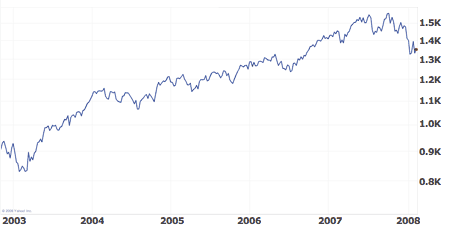
In looking at the S&P chart below over the last five years, however, it’s clear that as bad as this development is, and as accurate as the prediction was, pulling out of the U.S. economy — at least so far — would have been a bad idea. “So far” being the operative qualifier there. :|
UPDATE: On a related note, this animated primer of the subprime mess is hilarious.
Slam Dunk Startups
I often hear people say things like “if only I thought of YouTube a year before YouTube did, I’d be rich”, implying that given first-mover advantage, that person could create a company as great as YouTube. A statement like this completely disregards just how difficult YouTube was to build, from having the balls to allow brazen copyright violation, to building a great user experience, to scaling out the ability to serve millions of video streams a day. In other words, 99 out of 100 people who may have had the same idea at the same time would have failed to create anything remotely as successful as YouTube.
Other startups fall into the same class. Companies like Google and Amazon owe most of their success to great engineering, great execution, and great scaling.
But which are the startups of the last ten years which really do owe most of their success to someone simply having a smart idea first and acting on it quickly? Perhaps an easier way to ask this question is “if you could have one business idea from the last ten years as your own, which idea could you most assuredly turn into a success?”
In trying to think of good examples, the best one that came to mind for me was HotOrNot.com. Super simple idea. Developed by two people. Very low expenses. Millions of dollars in revenue per year.
Any better examples out there? What are the most slam dunk ideas of the last ten years?
Completing the Cycle of News
I gave a talk today at an all-company meeting over at MSNBC on the subject of “news ecosystems” — the main point being that in order to produce the best news experiences in the world, you need to think of your audience as much more than just a passive sponge for your content. Passive news consumers can turn into active news participants if you give them the right environment.
This month, we launched a feature on Newsvine called “The NBC Nightly News Discussion Club” (available at nightly.newsvine.com). In concert with MSNBC’s new video player, the Discussion Club is the first and only example of a network news agency making every single segment of their 6pm national news broadcast available for instant viewing and discussion online. So if you’re watching the news and you see a segment you want to talk about with other people, you’re no longer limited to whoever else happens to be on the couch. There’s now a universe of people to discuss it with online.
It would be interesting enough if that was the end of it. However, we’ve also included the ability for users to submit questions to Brian Williams and have them answered in video form, right on the site. The first example is below:
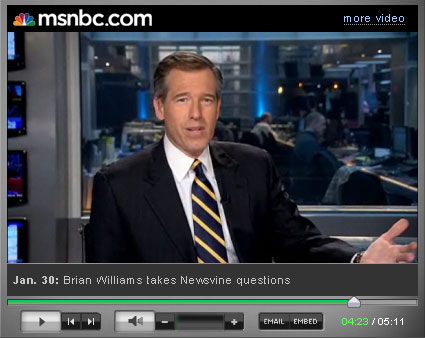
So what we have so far is:
News agency broadcasts the news -> audience discusses the content -> audience shoots back questions to the anchor -> anchor answers (select) questions right on the site
Maybe I’m biased because this is partly my baby, but I just think that is super cool, and super significant.
I also think it’s great that Brian — probably the most recognized face in U.S. National news — answers all questions off the cuff, with no teleprompter, and with a level of frankness you don’t often see on national news broadcasts. In responding to one of the questions, he even mentions his political affiliation (independent), which is rare for news personalities to do.
There’s Not Enough In The Air
A lot has been made about how MacWorld 2008 was a disappointment. Uninformed reporters and analysts who look only to wall street as an indicator of the show’s success were quick to point out the decline in Apple stock following the show, but let’s not be stupid here. Not only is the old axiom “buy on the rumor, sell on the news” almost always true, but of the approximately 30 tech stocks I personally follow, almost all of them are down sharply in January, especially on the day of the MacWorld announcements. Google is down almost 18% in January on general market sentiment alone. Furthermore, anybody who uses 2007’s MacWorld as a measuring stick for what Apple should announce every year is a fool. The iPhone is in many ways, a once-in-a-lifetime product announcement, not to be expected again for a long, long time. The only other announcement Apple has ever made of such instant magnitude was the original Macintosh in 1984 (the original announcement of the iPod was actually met with widespread apathy).
That said, I think the show this year was a success (and mostly in line with my predictions), with the surprising exception of the one product I was most excited about: The MacBook Air.
I’ve waited for a new Apple subnotebook since ditching my beloved Duo in 1997. That’s ten long years, having mostly leaned on the 12 inch Powerbook until it was snatched out of the lineup a couple of years ago without any notice. In order to move into the Intel Mac world, I was essentially forced into a 13 inch MacBook, which I have to say, I don’t particularly care for. It’s a fine machine, for the most part, but it’s bulkier than my 12 inch Powerbook was, and more importantly, it gets greasier than a KFC dinner bucket when you touch it. The “SmudgeBook” as people call it, annoys me more than I thought it would. So much so that I have to give it a rubbing alcohol sponge bath almost every week.
So by all measures, I am the absolutely ideal customer for an Apple subnotebook. If they can’t sell one to me, they have a problem.
And unfortunately, I’m not buying one.
Even more unfortunately, it’s only one and a half specs that completely kill the proposition for me: the 80 gig hard drive (huge deal) and the 2 gigs of RAM (somewhat huge deal). I don’t care about the slower processor, the lack of swappable battery, the minimal connectivity options, or the absence of removable media. These are all things you give up for the incredibly sexy shell. But can anyone comfortably get by on 80 gigs these days? My MacBook holds 230 gigs. And what about the 64 gig “high end” MacBook Air for a thousand bucks more!??! Who the hell is going to buy that model? I bet the lower end model outsells the higher end one at least 10-1.
Steve Jobs said on stage that they know micro hard drives very well, due to all of the iPods they sell, so why couldn’t they have thrown a 160 gig drive in there? It’s already in the high-end iPod Classic. Maybe it’s a heat issue, I don’t know. But what I do know is that at least in my case, it’s the difference between a sale and a non-sale. Between reading The MacBook Air Austerity Program and thinking about moving media storage completely over to something like TimeCapsule, it’s just more hard drive management than I’m willing to take on. And you know it’s going to be a monthly worry.
Memory is the second spec that I think Apple flubbed. If you’re going to offer a slower processor, you need to at least make up for that with ample RAM and ample hard drive space. Free memory and HD space can often mean a lot more to performance than processor speed. I mention the RAM thing as a “half spec” that I don’t like, because if the hard drive issue was addressed, I’d overlook the RAM shortcomings and buy a machine.
So in the end, we have a product line that a lot of people are really clamoring for, but a single spec that is going to turn a good portion of that consumer base away. To make matters worse (or better, depending on how you look at it), we *know* that the MacBook Air will sport at least a 160 gig hard drive probably before the year is over, so there is essentially a zero percent chance people like me will suck it up and buy one now.
The pessimists will say Apple has produced another Cube… a smaller, less functional machine that nobody has much of a reason to go out and buy. The optimists, on the other hand, see the footprint for what will one day be one of the most popular computers around… just as soon as its brains catch up with its body.
Me, I’m an optimist, but it’s going to be a tough several months waiting for revision two.
MacWorld 2008 Predictions
 The only thing more exciting than actually using a new Apple product for the first time is hearing about it for the first time from Steve Jobs. And only slightly less exciting than either of those things is reading everyone’s pre-show predictions about what will be announced.
There are no reliable soothsayers in the world of Apple prognostication and anyone with any guts will get things either completely wrong or partially wrong a lot of the time, but I hold that my record is as decent as anyone’s, often times getting bold, unpopular, against-the-grain predictions mostly right but being a little early on timing. So here’s my crop for this year:
The MacBook Nano
I’m not sure about the name here, but it would work given that the Nano is Apple’s best selling model of iPod and the company might want to test that branding out on another machine. The MacBook Nano is not a tablet, as many have been reporting, but merely the thinnest, sleekest subnotebook ever produced. Think the thickness of your MacBook’s folding screen times two… or about 30% thinner than current MacBooks. The machine will have a full keyboard and no removable drive, as is custom for subnotebooks, and will definitely not be a pure “tablet” in form factor. That said, it wouldn’t surprise me if the hinge on the screen allowed it to flip 180 degrees to create tablet-like mode, if you ever wanted it. This could be potentially quite functional if it used multi-touch but might also be useful while watching a movie or giving a presentation.
There have been whispers that this machine will tap Flash memory for some nice tricks like faster bootup times. If this is the case, I expect all other Apple notebooks to receive the same treatment in fairly short order (though maybe not at the Expo). One thing I’d also like to see on this machine is a Flash memory slot so that users can plus their SD cards directly into the device and transfer media. Given that 1 GB SD cards are down below ten dollars now, that could lessen the blow of not having an optical drive.
This machine will unfortunately cause me to put my barely two month old MacBook on eBay as it is the machine I’ve wanted ever since Apple stopped making their last subnotebook, the Duo Dock.
.Mac Finally Gets Great
I thought the release of the iPhone and Leopard would coincide with a massive revamp of Apple’s .Mac service, but it never did. I was three years early in calling the iPhone, but I don’t think I’m that early on this one. Come January, .Mac will become the missing link that let’s you sync your entire life, over-the-air. If you’re shocked that the iPhone can’t do something as simple sync with your iCal/Contacts/.Mac over-the-air right now but can do so in just a few seconds using a standard USB cable, you’re not alone. If you think Steve Jobs hates having his phone out of sync when he’s on the road, you’re also not alone. These features are coming, and while you can argue they should have been there from the start, you can also argue that they belong as part of a subscription package like .Mac. In order for Apple to increase their .Mac subscriptions 5-10x, they need to be part of a well orchestrated “Life Sync” campaign, and sold separately from the iPhone itself.
I believe Apple’s plan involves two concurrent strategies for getting into the life-syncing bloodstream: a) play nice with Exchange (current support via IMAP barely qualifies), and b) play nice with open technologies like IMAP and iCalendar/WebCal (already in-progress). Most big companies these days run their corporate mail on Exchange. Know what Apple runs internally, at least as of very recently? Netscape’s old mail server. I’m serious. Running that mail server for so long taught them how inferior it is to Exchange, but also taught them that by using the right combination of open technologies like IMAP, iCalendar, and WebDAV and then creating the right glue to tie it all together for the end user, they could produce an enterprise-quality experience rivaling Exchange and even beating it in many areas. Via this new and revamped .Mac service, you’ll be able to play nicely with most of the major platforms out there: Exchange, IMAP (and by extension Gmail and Yahoo Mail), WebCal, POP, and who knows what else. In 2008, .Mac will finally become the big revenue driver Apple expected it to be years ago.
One really nice side effect of the iPhone on the rest of Apple’s business is that it has shown them, in no uncertain terms, how important it is to play nice with Exchange. In order to play nice with Exchange, the integration must run deeper than phone-level; penetrating Apple Mail, iCal, and syncing services. I can’t say how yet, but I am currently running my life in an Exchange/Apple Mail/iCal/.Mac synced fashion. The way I’m doing it is really hacky and doesn’t involve any new software from Apple or anything, but it’s shown me that it’s already possible.
The Netflix Killer
I predicted last January that Apple TV would be released but that its killer feature would be download-to-rent movies. The box launched, but with no such killer feature, and has thus far tanked. Download-to-own movies have always been a dumb proposition to me and it’s hard to see how Apple can’t feel the same way. Having worked at Disney, however, I fully appreciate how the business side of movie distribution can get in the way of the product innovation side, so it’s entirely possible that the only reason Apple TV didn’t launch with a bevy of download-to-rent releases was that business terms couldn’t be finalized in time. A year later, however, my suspicion is that a lot of those issues have been worked out. Come January, expect any Apple TV box or iTunes equipped device to be able to download-to-rent a selection of movies rivaling what Netflix and Blockbuster offer.
Download-to-rent is why I haven’t paid more than 60 seconds of attention to the entire BluRay vs. HD-DVD slugfest for the past four years. In the end, I don’t want a disc. I just want the bits. And I only want them until I’m done watching the movie.
iPhone
I don’t think we’ll be seeing any major hardware changes to the iPhone at MacWorld. Maybe some more memory and some price adjustments, but the bulk of the time spent talking about the iPhone will be related to the aforementioned syncing capabilities, a new iPhone SDK, and probably a new iPhone OS update as well. Jobs will have plenty of sample apps to show off and will detail a certification program whereby developers can submit their apps in order to get into an Apple-hosted directory. If Apple’s smart, they will set up some sort of revenue sharing program for app developers, although I’m not exactly sure how this would work. Apple could do all of the billing themselves but this strikes me as a big undertaking. Conversely, they could charge developers a one-time or recurring fee to be listed in the directory, but this strikes me as not very lucrative since they’d make the same amount on an app downloaded one time as an app downloaded one million times. Perhaps the solution is to offer developers a choice: a) do everything on your own, including billing and hosting, and we won’t touch your app or take a cut, or b) use our system, pick your price, give us your tax information, and we’ll take a small cut, but we’ll also bless and promote your app, thus increasing your sales.
Who knows. Maybe the best solution would be to stay completely out of the revenue stream and just concentrate on profiting from the hardware. We’ll see.
We also will most certainly not hear anything about a 3G-based iPhone. There is no way Apple will peep a word about such a device unless it is produced and ready to ship. iPhone sales expectations are already very high and to risk creating a dead spot in the sales cycle just wouldn’t be smart. Instead, you’ll be hearing at MacWorld only the things that will be affecting and improving the current generation of the iPhone. In other words, things that will either a) get you to go out and finally buy one (3rd party apps, more storage, more functionality) or b) make you all the happier that you already own one.
Leopard Update
Leopard seems to have taken longer to release than expected, and whenever that happens, you can bet that it probably shipped with a few features missing as well. One feature we know for sure is missing is wireless backup via TimeMachine. Seeing as TimeMachine is one of only a small handful of features in Leopard that materially changes my life for the better, I’m super anxious to be able to use it wirelessly. Hauling my portable hard drive out of a cabinet, plugging it into the wall, and then connecting it to my laptop via Firewire while sitting on my couch just isn’t something I’m going to do every day. I’ll be lucky if I remember to do it every month… which completely kills the purpose of TimeMachine. My portable hard drive should be tucked away and connected to my wireless network (either wirelessly or by ethernet) and whenever my laptop joins the network, TimeMachine should silently do its thing. This is no doubt the way Apple has envisioned it all along, and either in January or shortly thereafter, I expect a Leopard update to add in this functionality as well as several other things. Syncing and .Mac integration should receive an upgrade, as mentioned above, as well as a ton of fixes to all of the little weird things about Leopard that don’t seem quite right yet.
Parallels
This is really going out on a limb, but I also think Apple will purchase a stake in SWSoft, the makers of Parallels. SWSoft is currently funded partially by Intel’s venture group, which affords Apple a tiny bit of influence (being friends with Intel and all), but there is no official relationship at this point. Although Boot Camp is a nice thing to have in Apple’s back pocket, my belief is that solid software-based virtualization of Windows is of great strategic value to Apple. Microsoft apparently thought the same thing when they purchased Connectix, the makers of the previous leader in Windows Virtualization, Virtual PC.
SWSoft’s first and only institutional round came in mid 2005 in the form of $12.4 million. If there is another round between now and an IPO, I would think Apple would love to be in on it — a lot of it. After all, with $15 billion in the bank, one can argue that it’s the company’s responsibility to start making a few more investments. Anyway, like I said, this is major limb walking, but no guts no glory!
In Conclusion
All in all, expect another solid MacWorld Expo here with a) the world’s sexiest subnotebook, b) major iPhone advances on the software functionality side, c) a bonafide Netflix killer, and d) major syncing and .Mac improvements. It may be a decade before another Expo tops 2007’s, but game-changers like the iPhone just don’t come around very often.
As far as products you won’t see, I put a pure tablet at the top of this list. I’ve seen reports that a tablet release is “imminent” at the Expo, but I just don’t see the market for it. Perhaps the only semi-useful application I see for it would be as an eBook reader. Like a better looking Kindle maybe. Still, not worth Apple’s time in my opinion. Not gonna happen.