Keeping Up With the Markets
 One of the best qualities of great bloggers is their ability to act as filters for entire genres of content; finding great new stuff on the web, formulating insight on said stuff, and then publishing the results for your easy consumption via RSS.
This sort of intelligent content curation is extremely helpful should you decide you are suddenly interested in a subject you previously eschewed.
Interested in modern culture? Try Kottke.
Interested in Apple? Try Gruber.
Interested in media and pop culture? Try Rex.
Interested in emerging technological novelties? Try Waxy.
These sites are all well-known within the geekosphere, because most of the world’s RSS feeds are still consumed by us — hyperaware geeks. But what if you find yourself suddenly interested in a subject that is best curated by much less technical people? Something like botany, or philanthropy, or philately. Finding the best source on subjects like these can be tough.
One such subject is investing and personal finance. The financial world is chock full of some of the most uninteresting and meaningless stories on the web. Whenever the Dow drops a lousy 10 points it’s “Markets Crushed by Investor Worries”. And when it inches upward, it’s “Dow Rebounds On Rate-Cut Optimism”. These aren’t the sort of stories that will do anything for you as an investor. In fact, these days many of them are actually written by computers!
So where is a grasshopper to find the week’s most interesting and useful financial observations in one place? My new favorite place for such things is:
Charles Kirk’s The Kirk Report
Kirk provides a short post almost every day with some quick market observations and then a bevy of the most interesting financial links he’s read throughout the week. Things like how to bet on a dollar rebound by investing in Canadian lumber or what doomsday would look like for the U.S. economy. Interesting stuff.
It’s a perfect one-stop-shop for anyone wanting to keep up with market news and insights but lacking the time to check 100 financial news sites every day. I highly recommend it.
Why is Lobster Cheaper in Sushi Restaurants?
So I was at a sushi joint last night and ordered the “Lobster Bake” — essentially, a baked lobster tail, served on top of a very tasty chili aioli sauce. It was $15.
Upon paying the bill, I remembered that the last few times I’d ordered lobster at a Japanese restaurant, it had always been under $20, and the last few times I’d ordered it at a steak house, it was more like $60-$90.
What accounts for the difference in lobster pricing at steakhouses and Japanese restaurants? Does anyone know? I’ve searched around and haven’t found anything. Although I love lobster, I’ve always considered the quality differences of it to be mainly in the preparation. Is it the case that steakhouses are really buying expensive lobsters and Japanese places are buying cheap ones, or are they just marking them up differently because lobsters are not a main attraction in Asian cuisine?
MSNBC Redesigns – Taste The Rainbow
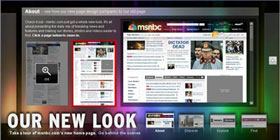 This weekend, msnbc.com began the multi-day process of rolling out their new redesign. It’s really, really nice… you should check out it.
Just so no one accuses me of kissing up to my new partners, I will say that I thought the last redesign several years ago was a bit of a step backwards from the landmark Roger Black look of the late 90s, but this newest redesign is not just a step forward, but a giant leap for newskind. It is not just a collection of features shoehorned together under one grid but a rather well orchestrated piece of communication design, worthy of further examination.
Let’s check out what’s going on under the hood:
Getting Rid of the Blues
Msnbc.com has always turned to blue as the primary color for its palette. Sometimes it’s royal blue, sometimes it’s electric blue, sometimes it’s subtle, and sometimes it’s dramatic, but it’s always been there — until now. The new palette is white, black, and grey with the spectrum of rainbow colors from the NBC peacock sprinkled tastefully throughout. It’s tough to pull off a rainbow palette in web design but this one is very sharp.
Speaking of blue, the shade chosen for all of the anchor text around the site is also very nice. For better or for worse, blue has become the de-facto apparel for hyperlinks on most mainstream web sites, but even the choice among blues is important. #0000FF is dated, unsophisticated, and highly lame, but there are still sites that use it. Interestingly, MSNBC and CNN have picked almost the exact same shade of blue in their latest redesigns, but hey, that just means they both have good taste.
Typography Tradeoffs
I’ve never liked Arial. It’s always seemed like nothing more than a font of last resort for those needing a widely available, compact sans serif. It’s plain, it’s unsophisticated, and it just screams “default” to me. For this reason, I was a bit disappointed to see the MSNBC redesign make such heavy use of Arial, particularly as display type. Surely something a bit more refined like Tahoma could be used. Or maybe even specify something like “Helvetica Neue, Corbel, Tahoma, Arial” so that users of OS X and Vista would get nicer sans serifs, most others would get Tahoma, and then Arial would be the font of last resort.
I asked Ashley Wells, msnbc.com’s Creative Director, about the Arial situation and he gave me a surprisingly satisfying answer: because msnbc’s new publishing system is very much WYSIWYG, editors are charged with not only writing headlines, but essentially designing them too. Meaning, how a headline wraps can have a dramatic impact on the presentation of the page. By using Arial, these wraps can be precise across most browsers. This is such a non-webgeeky way to think about publishing. I love it. Typesetting has always been something MSNBC has done a lot better than their competitors and it’s great to see that even as the company moves away from its Photoshopped-type-on-images style, the focus on typography is not completely lost.
Arial as a way to improve typography. Who would have thunk it.
BIg News, Big Treatments
One of the things I’ve always loved about MSNBC is that when big news happens, the layout of the front page adjusts to properly frame the importance of the story. At ESPN we called this “war mode” and it can only be accomplished by a mix of smart design and editorial participation. In the world of never-ending, unflavored news feeds we seem to be moving towards, it’s refreshing to see a news organization that still believes in the power and importance of layout.
Although the old msnbc.com had more layout flexibility than its competitors, the new site is several cuts above. There are dozens of layout options available for editors and that can increase infinitely as new ones are envisioned. So while most other news sites just pump their top stories into a standard headline-on-top-of-photo box, msnbc.com is actually designing their cover every time they publish. It makes checking the site several times a day that much more interesting.
Coding to Standards
As everyone who has ever worked on a big site knows, the longer you go between redesigns, the cruftier your code gets. Even the cleanest of redesigns tend to decay over time as more people get their hands on the code. WIth this latest redesign, however, MSNBC is debuting a totally new version of their home-grown publishing system (“WorkBench”)… one that is designed to — among other things — allow for feature extensibility without sacrificing the foundation of clean code that now anchors the site.
Before all of you standardistas and validatorians start piping up about inline CSS and random code oddities, realize that the site is very much in flux over these next few weeks as kinks get worked out. Also realize that a redesign of this magnitude requires the retrofitting of a lot of old code and templates that can’t always be eliminated with the flick of a switch.
As a result of the attention MSNBC is paying to web standards, the site now works equally well in all major browsers. It loads quickly, renders quickly, and is a joy to interact with.
An Open Dialog with Users
As part of the redesign process, MSNBC set up a blog to communicate with users about the redesign and all ongoing development efforts. These sorts of things are tricky because they tend to attract a lot of “drive-by” comments from users (e.g. “WTF! I hate it! Bring back the old!”). Once you filter out the inevitable noise though, there is usually plenty of insight to learn from. Having a blog to communicate with your users seems almost mandatory these days, but what I like about MSNBC’s is that it’s a sincere, serious effort. It’s just not a default TypePad installation that some PR flack pens to once a month. People from all sides of the organization have already written entries and answered questions, and it should be obvious to anyone who is paying attention that this is a company that cares about its community.
Newsvine Integration
I wish I could say that the Newsvine team had any significant role in this redesign, but we haven’t. This has been almost a year in the making and it’s all Redmond. That said, Newsvine did get a minor speaking part on the community page, and we look forward to further collaboration in the coming months.
The Bottom Line
This redesign is a perfect example of why “big media” is still alive and well, despite what some people would have you believe. It is thoughtful, it is innovative, and it is something no six-person company could ever produce. It is something, in fact, that most 300-person companies could never produce. As big media takes more cues from little media and little media returns the favor, both sides of the spectrum just get better. And that is great news for the news business and the news consumer.
RAM Arbitrage
 So I finally bucked up and ordered a black MacBook yesterday. It seems like Intel Macs have been out for 10 years now, but this will actually be the very first Intel-based Mac I’ve ever used. I tend not to upgrade computers more than once every couple of years, and the product cycle just happened to dictate the purchase of PowerPC iMacs in the office two years ago and a PowerPC 12-inch Powerbook around the same time.
In configuring this MacBook at the online Apple Store, it struck me how much Apple *still* charges for RAM, and gets away with. This is not a new phenomenon as it’s been happening for many, many years, but the total cost difference between Apple-installed RAM and third-party RAM now stands at a whopping $730 for 4GB of RAM! Note that they are both third-party products, from a manufacturing standpoint.
In other words, to max out my MacBook’s RAM, Apple charges me $850, while if I go through my trusty RAM comparison shopping site DealRam, I am pointed to NewEgg, which ships me the same amount of RAM for $120. As a point of comparison, Dell charges $465 for an extra 4GB… still outrageous, but not a 700% markup!
That is just astounding to me. Surely I’m missing something, but is there another store in the world that charges over $800 for a product that can be had for under $150? And I don’t want to hear any arguments about quality of RAM either. If you happen to get some bad RAM, you can always exchange it (note: I’ve gotten bad RAM from Apple before too… it can fail no matter who makes it).
I suppose I can’t actually be mad about this since Apple makes it perfectly possible for informed consumers to buy their own RAM, but at these prices, I would love the ability to save an additional $150 (Apple’s price for one 1GB stick) by having my MacBook ship with no RAM whatsoever.
Msnbc.com Acquires Newsvine
 I grew up in an NBC household. Some of my earliest TV memories were sitting in the living room at 6pm with my parents and watching the nightly news with David Brinkley, John Chancellor, and later Tom Brokaw. I didn’t always understand what was going on in the world, but it was my half hour nightly glimpse into life beyond Pacific Palisades, California, where I grew up. Old habits die hard when it comes to news network allegiances and I continued to turn to the peacock for news into my teen years and through college.
In November of 2000, that all changed. Although politics have never interested me in the least bit, the Bush/Gore election and the epic amount of controversy that resulted from it turned the news world upside down. In my mind, that was the beginning of the 24/7 news cycle, at least in the United States. I found myself instantly wanting more than the standard 30 minutes of national news NBC gave me every night. During this frantic period, many people turned to cable news for their 24/7 news fix, and that’s when I found MSNBC.
Suddenly, whenever I turned on my TV, there was election coverage available. Who was this Ashleigh Banfield girl? I didn’t know, but I liked her. Where did all of these reporters suddenly come from? And whoa, what’s this? A double-length version of the Nightly News anchored by Brian Williams? I’m in!
Fast-forward several months later when everyone thought the 24/7 news cycle might have peaked, and then came September 11th, 2001 — the most shocking event that anyone alive today has ever witnessed and probably ever will. News activity was completely off the charts again. And who was right there with the best 24/7 coverage again? MSNBC. For the next several years, as the incident slowly turned into the Afghanistan and Iraq conflicts, I found myself still turning to the Micro-Peacock — both online and off — for my most important news consumption. It is still the source from which most of my mainstream news comes from.
It is therefore with great pride, that I can announce the company I co-founded two years ago, Newsvine, has just been acquired by msnbc.com.
Wow, I’ve been waiting a few months to say that. It feels great to finally make the news public.
Msnbc.com is one of the most decorated, highly trafficked news sites on the web, and is ranked as one of the top news site overall, according to virtually every measurement service. More than one billion page views a month strong, and run by some of the smartest people in the industry, msnbc.com represents a lot of what online news ought to be about: immersive interactive news experiences, award-winning journalism, stunning photography, thoughtful UI, and scalability a startup like Newsvine could never dream of achieving on its own. It is a separate company from the TV side of NBC News and MSNBC the cable channel, but all the organizations work together to complement each other online and off.
Msnbc.com, the news site, has always been a daily visit for me. They were the first to have a professionally typeset cover story when they launched their legendary Roger Black design back in the 1990s. They’ve also produced some of the best interactive news experiences like The Darkest Day (9/11) and Rising from Ruin (Hurricane Katrina). Throw in the stunning photo galleries, a wealth of news video, and an impressive army of award-winning print journalists and it’s easy to see what makes the site so special.
So why would an independent, cost-efficient, growing startup like Newsvine which has taken very little venture capital want to join a huge organization like msnbc.com? The answer comes down to global impact. Our goal at Newsvine has always been to spread the ethos of participatory news as far and wide as possible, and what more dramatic way can that be accomplished than with a partner who reaches 85 million computers a month and has an offline presence on nearly every television set in the country?
We never set out to prove that grassroots media was better than mainstream media or vice-versa. The theory, in fact, has been quite the opposite: that given the right environment, an ecosystem where big and little media make each other stronger can be developed. This has been proven out on the Newsvine site itself since we launched about a year and a half ago, and it’s now going to go prime time. We’re so excited.
One the most important aspects of this deal for both organizations was that Newsvine will continue to run independently, from a brand and operational perspective. They are two different sites with two entirely different brand expectations. That said, we’re thrilled to be working with a parent who resides right across Lake Washington from us, a mere 20 minutes away. Of all the companies who’ve come knocking since launch, never has a relationship of such geographical advantage matched this one. It’s a win for the Newsvine community, a win for msnbc.com, a win for our investors at Second Avenue, and a win for the Seattle region as well.
Wish us luck as we continue our mission of evolving online news.
More coverage:
Most Profitable Web 2.0 Business: Conferences
The tech conference business continues to amaze me. I just received an email a few minutes ago from the organizers of the annual Web 2.0 Conference in San Francisco telling me I am a V.I.P. and I can attend their conference under this special classification. Sweet! I’m thinking free admission, maybe hotel and airfare too. Something like that.
In reading the rest of the email, it appears I’m being offered the V.I.P. rate of JUST OVER THREE THOUSAND DOLLARS. And that’s $500 off the Very-Unimportant-Person rate!

Who has the enthusiasm to pay these sorts of prices? Even when I worked at Disney, a multi-billion dollar corporation, I would never even dream of taking $3000 out of the budget for an event like this.
Nothing against the conference… I’m sure it’s great. I just can’t think of a single conference I’d pay over a $1000 for (and even that is expensive) unless part of the deal was a personal dinner with Steve Jobs, Richard Branson, and Gisele Bundchen.
In a way, I guess these sorts of conferences are like business travel for airlines. They figure since companies are footing the bill, the price elasticity of demand is low.
As for me, I’d rather spend that $3k on any of the following:
- One week trip anywhere in the world (with a decent budget!)
- Husky season tickets for both basketball and football
- A donation to a charitable cause.
I guess you can’t blame the organizers of the conference for charging $3000 because clearly people are willing to pay it, but if you really want individuals showing up at conferences, it would seem that Techcrunch20 or unconferences would be the better routes.
Oh well… off to go plan my first conference I guess. I’m thinking “Fortune 100 Giselefest 2007”.
Newsvine Relaunches… Announcing Evergreen

Kelvin: One of the many subtle joys of the new Newsvine.
Call it a redesign. Call it Newsvine 2.0. Call it whatever you want, but today Newsvine is proud to announce the first major overhaul of our site since launching a little more than a year ago. It’s an exciting thing for the team and for the now 600,000 people who visit the site every month because it not only provides a hugely enhanced front page but also showcases a lot of the great technology we’ve been building behind the scenes over the last several months.
Newsvine Evergreen begins today with the relaunch of the front page but is part of a much bigger effort to spread the vine outside the walls of our own domain and into all corners of the internet and blogosphere; the goal being to bring the news to wherever it naturally wants to go.
So what’s new so far?
Modules!
The most common request we get on Newsvine is that people want to emphasize or de-emphasize certain parts of the front page. We have our own ideas for what the front page of a news site should look like and you have yours. Most major news sites attempt to solve this problem by maintaining their editorially imposed front page and then offering a “My” page which users can play around with and customize. The result of this strategy is almost always two-fold: 1) Barely anyone customizes. 2) Even among those who customize, there is hesitancy among users to give up their daily reading of the front page in favor of the “My” page. This is evident from sites like ESPN and Yahoo News, both of which have feature-rich “My” pages but do a ton more traffic on their front pages.
So the question for us became, how do we provide a front page that contains the ideals of a major news site but still allows for complete customization? The answer: modularization. The new Newsvine front page begins as we think many users would like it: big top story, most popular seeds up top, most active stories prominently placed, and so on down the list. But as you go down each column, you’ll notice tons of new things which you may like better than the things at the tops of the pages. If you do, just start draggin’ stuff around until you’re happy. Feel free also to close modules you don’t use or add new ones that aren’t in the default set.
Local Headlines and Weather
Another frequent request we’ve gotten over the past year is to beef up localized content around the Vine. Since weather is a staple of any local news diet, we’re now automatically detecting your general location based on IP address and serving you up a 5-day forecast right on the front page, courtesy of Weather Underground. We are also now the only major news site that gives you the option to display your temperature in Kelvin.
Did you hear that? We said Kelvin! So now when it’s freezing outside, you can switch over to Kelvin and bask in the illusion that it’s a balmy 270!
We’ve also gone through and collected the local news RSS feeds from hundreds of newspaper sites around the country so we can automatically show you your local news in a module alongside the rest of your content.
Newsvine Live
Our live feed of all actions occurring within Newsvine now takes a seat at the grownups’ table with this redesign. Newsvine Live is a great way to discover new content before it gets popular, and it’s an easy way to get yourself some exposure as well.
The News in Pictures
Sometimes you’re not in the mood to read articles and would rather get a visual tour of what’s newsworthy on any given day. The News in Pictures is a continuously updated slideshow — with captions — of all the latest content coming in from the AP. Sure you’ll see the occasional unflattering mug shot of an escaped convict, but we’re actually quite surprised and pleased with the general quality of the photos that roll through this module on a daily basis. We have other plans for this module which include accepting user submissions, but for now, enjoy the first incarnation.
Newsvis
Newsvis is a visualization tool we’ve developed to help you easily identify how much of Newsvine you’re really covering. So much news flows through this place that often something extremely voteworthy or commentworthy can be missed entirely by casual users. Newsvis shows you a colorful map of all the latest popular stories and clues you into which ones you may have missed.
External RSS Feeds
Let’s say the Associated Press, The New York Times, The Washington Post, Techcrunch, and every other source linked to or hosted on Newsvine just isn’t enough for you. Let’s say you live in the tiny village of Podoliantsi, and the Podoliantsi Post-Intelligencer is the only news source covering your neighborhood. As long as they have an RSS feed, you can now add it to your Newsvine front page… along with any blog you’re interested in, any Twitter RSS feed, or any Del.icio.us linkroll.
Newsvine Group Showcase
Since introducing Newsvine Groups a few months ago, we’ve watched as people have self-organized into hundreds of social circles around interests, locations, and political ideologies. Groups has never had any marketing behind it or more than a small item in the navbar, but even in this semi-stealth state, it’s shown its popularity. With the launch of the new front page, however, Groups gets its own module to showcase a weighted random assortment some of the more active organizations around the Vine. The ultimate goal of Newsvine Groups is to take the pool of hundreds of thousands of people who visit Newsvine and create a vast array of smaller populations, with more meaningful personal ties between members.
Top Seeds from Source
Some of the best content on Newsvine comes from the New York Times, The BBC, The Washington Post, and ESPN, but up until now, there’s been no easy way to see it all grouped by source. We’ve started you out with a New York Times module by default so now you can see the latest New York Times seeds all in one place. Prefer Fish ‘N Chips to Pastrami On Rye? No problem… switching to the BBC is one click away.
Super Widescreen
With all of this new content, you can imagine that screen real estate could get a bit tight. For this reason, we’ve enabled users with gigantic monitors to expand their layout to four columns and a whopping 1300 pixels of width. If you’re so inclined, just click the little green button on the right side of the screen and spread out like a polar bear. Hint: We think the coolest two modules to push over there are weather and Newsvine Live. Give it a shot.
So What’s Next?
We can’t say right now, but it’s election-related and you can look for it in a few weeks. We hope you enjoy the new and emerging Newsvine, and if you’re already a member, we thank you so much for your patronage!
Pagination and Page-View Juicing are Evil
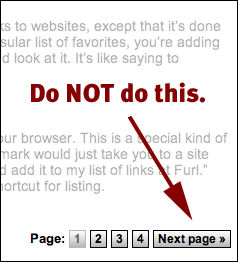 You’ve seen it a thousand times. You’re reading a great article on the web, you get to the bottom of the page, and there it is:
1 | 2 | 3 | 4 | 5 | Next >
The pagination tattoo. The mark of the beast.
Over the last several years, many publishers have convinced themselves that breaking up stories into sometimes as many as ten pages is an acceptable way to present content on the web. The realistic ones at least admit that it’s a cheap way to boost stats. The disingenuous (or naive) ones actually posit that they are improving readability and usability for their audiences by reducing scrolling. Because scrolling is so hard.
I’ve seen both rationales presented by colleagues, and frankly, I’m not on board with either one. There are really only two instances where I find pagination acceptable, and they both seem rare on today’s web:
- If an article is extremely long. Like 20 screens worth. And even then, it should be broken up by “Acts” and not necessarily word count. Break it up as if it were a play and try to never have more than a few Acts.
- Slightly related to item 1, even a short piece can be functionally broken up. Imagine a much shorter version of that great Washington Post article about the violinist in the train station. The article has several video clips strewn throughout. Those would be logical places to either start or end each Act.
Instead, what I’m seeing more and more of is ridiculous pagination for the sake of juicing page views. Take for example this article which was seeded sarcastically to Newsvine the other day. It’s from a site called Associated Content. The article is a lousy 1504 words and it’s broken up into four pages! I’ve read cover letters that are longer than that.
How is a reader to endure a user experience like this and feel respected by the publisher? Maybe if I’m reading Malcolm Gladwell, I’ll give the guy a break because I’m so lucky to be reading his masterpieces in the first place, but the fact of the matter is that 99% of content on the web (and in the world) is not stuff we’d bow down to, so we should at least hope to be respected as we’re trading our attention and associated ad revenue for some reasonably entertaining or educational text.
As the founder of a news startup, I’m fully aware of the constant pressure to increase page views month over month, but at some point you have to ask yourself if the page view is your most important metric over time. If you could choose only one of the following — long term — which would you choose: a user who consistently generates 10 page views a day on your site but spends only 5 minutes with you, or a user who literally stares slackjawed at the screen for two hours a day with your site running on it, generating only one page view?
Your accountants will always pick the former, but you should always pick the latter. In the long run, it’s not total HTTP requests that will determine how successful you are. It’s what percentage of any given population’s attention you earn. Don’t blow it by manipulating your readers.
If You Don’t Have Anything Nice To Say…
Let’s say, hypothetically, that a blogger was sent a free product/service worth about $500 by the company who sells the product/service. There is no specific requirement that the blogger write about the product/service, but it’s apparent that that’s why the blogger was chosen to receive the product/service.
Now, let’s say that the blogger has an overwhelmingly negative opinion of the product/service. It’s not dangerous to the world or anything but the blogger would never, ever use it, based on its design/utility/etc.
Given that the blogger *would* write something positive if his/her experience with the product/service was positive, it is his/her responsibility to write something negative if the experience is negative? Going even further, if the blogger chooses to simply not say anything at all (out of respect for the niceness of the company who sent it) is that unethical?
Upcoming Speaking Engagements
 Following is a list of upcoming speaking engagements. If you’re going to be at any of the below conferences, please let me know so I can say hi:
April 11 — Utah Advertising Federation, Park City, UT
If you’re in the Utah area around tax time, come hang with some smart advertising people at the AdFed conference in Park City. I’ll be doing the keynote and the subject will be harnessing online behavior with participatory media.
Canceled!
June 21-22 — An Event Apart, Seattle WA
If you haven’t been to Seattle in June, it’s generally 70 and gorgeous all day and it doesn’t get dark until 10pm. If you’ve always wanted to visit, An Event Apart Seattle is your perfect excuse. This year’s conference will be terrific and I’m looking forward to my city hosting such cyber-yodas as Jeffrey Zeldman, Eric Meyer, Jason Santa Maria, Andy Budd, Khoi Vihn, and the venerable Wolf. The subject of my talk will be “Civil Disobedience in Interactive Media: Making Thoreau Proud” and I expect it to be suitably controversial.
June 27-29 — serestandar.es, Sevilla, Spain
A week after An Event Apart, I’ll be heading to the Serestandar.es conference in Spain for a talk on sIFR and breaking rules on the web. I haven’t been to Spain in about ten years and haven’t taken a vacation in almost three, so I’m excited for the trip. Also speaking will be Croftie, Andy Budd, Jeremy Keith, Veerle Pieters, and others. Anybody know of any great scuba diving around that area? Canary Islands maybe?