Thoughts on The Dreamhost Meltdown
 As many readers of this blog know, I’ve been an enthusiastic user and supporter of Dreamhost web hosting since getting turned on to it by Stan a couple of years ago. The service has been great, uptime has been excellent, and you simply can’t find the amount of storage, bandwidth, and other options Dreamhost gives you at any other reputable host that I know of.
It has thus been with great stress that I’ve watched Dreamhost go from one of my favorite companies of all time to an unacceptably unreliable provider of web hosting in only a couple of month’s time. First it was some minor e-mail problems. Then, some short site outages. Then finally, over the last couple of weeks, I experienced a site outage of several hours and an e-mail outage of an entire day… among other things.
This is not world-ending stuff. Babies are not dying. But it was enough to make me consider both leaving the service and also dropping my public recommendation of them.
Both of these would be tough decisions for different reasons. Leaving would be tough, because frankly, Dreamhost is the best deal in town and I’m not crazy about migrating to another environment. Dropping my recommendation would be tough because, well — even though I didn’t plan it this way — it brings in quite a bit of money for me these days. In my two years of being with Dreamhost, I’ve directly referred 647 new customers. Dreamhost, being the cool company that they are, kicks users back $97 for each person they refer. Do the math. :)
That being said, I began recommending Dreamhost because I stood behind the service, and even at the cost of losing $30,000 a year in free money, I was prepared to walk away for nothing. Money aside, I’d always felt like I was doing readers a huge favor by turning them onto a such a great service. With that no longer being the case, it was time to do the right thing and pull my recommendation.
In the interest of loyalty, however, I wanted to give the company one last shot. I added a message to my web hosting recommendation page suspending my endorsement of their service until further notice, and sent them an e-mail to the effect of:
“When a guy making $30,000 a year by just including a text link to you guys is thinking about walking away, it means you have a big problem. I think a candid statement from the founder to all users is necessary… like now.”
I wasn’t expecting much of a response given the huge amount of e-mails the support staff is probably dealing with these days, but a staff member got back to me within a day and I was satisfied and impressed with what he wrote. So much so, that although I haven’t lifted the endorsement caveat, I feel like things are back on the up and up. And then, sure enough, yesterday came this:
Anatomy of an Ongoing Disaster — An entry on the official Dreamhost blog written by Josh Jones, the company’s founder.
This is a really great piece of writing. It’s exactly what I needed to hear, and it strikes the perfect balance of taking blame and explaining the series of unfortunate power outages that have caused problems not only at Dreamhost but at every site hosted out of this particular building in Los Angeles… including MediaTemple, iPowerWeb, and even MySpace! I didn’t even know MySpace was hosted out of the same building I was! I feel dirty now.
Anyway… long story short, if you host at Dreamhost or any other facility in the Garland building in Los Angeles, you should read the above blog entry. It doesn’t make me 100% confident that every hosting related problem is behind us, but it reassures me that everyone over there has been working around the clock to get this stuff fixed ASAP and that if the safeguards being installed now work as planned, reliability will be even better than it was before.
Can You Buy a Community?
I wasn’t going to say anything about Jason Calacanis’ announcement today that he was looking to buy Newsvine’s, Digg’s, and Reddit’s top link seeders for a thousand bucks a pop, but the fine folks at Reddit said it with zero words better than I ever could (note the logo):

It’s an interesting experiment for sure: whether you can take a user base of 12 million that isn’t a community in any way, pull their aging but comfortable portal out from under them, pay a bunch of users from other sites to entertain them, and then get them injected into a new community before they decide to go elsewhere. It hasn’t caught on yet, and I imagine that 99% of Netscape’s current user base has yet to vote on a single article, but it’s still very early in the game.
People like to point to Digg as a model that has clearly worked, and they are thus far correct, but one important thing to keep in mind is that other models may work as well and perhaps even better. There will never be only one winner in the community-driven news world. There will be many, and each will bring their own philosophy and style to the table. Our philosophy at Newsvine is to provide the best news reading, news writing, news gathering, and news debate possible. We’re only four months into our public launch and still have miles to go, but big companies trying to buy our best contributors isn’t what keeps us up at night… it’s continuing to evolve, continuing to innovate, and continuing to respond to what our community is telling us they want.
Reputations, Trust, and Atomic Publishing
It seems like the question comes up at every conference, interview, or personal publishing powwow: Can you trust bloggers as much as you can trust journalists?
render(); ?>
I always answer the question the same way: If you look at it in terms of “averages”, then no, you cannot trust bloggers as much as you can trust journalists. Looking at the averages, however, is the wrong way to answer the question. That would be like trying to answer the question of whether Italy or France makes better wine by dumping all the wine from each country into a vat, stirring it up, and then taking a sip from each.
Who cares about averages? What I really want is a few bottles of the best from each country plus maybe a sample of what one would consider “good table wine”. Armed with the best and the “typically good”, I can make a judgement as to who makes the better wine.
The same is true in the world of blogging vs. journalism. Since no one is going to settle for reading average journalism or average blogging once aggregation gets more intelligent, the real question to answer is “are the really good bloggers as trustable as the really good journalists?”
To answer this question, I always use three examples:
Om Malik
Om is a blogger and a journalist. The journalistic standards he upholds while writing for Business 2.0 are no different than those he applies to his blog, GigaOm. The man was a journalist before WordPress was even an apple in Matt Mullenweg’s eye. Om’s style varies a bit between his online and offline writings, and it is up to you to decide which you like better, but the unit you are deciding whether or not to trust in both cases is an atomic one: Om himself.
Walt Mossberg
Walt is a longtime personal technology writer for the Wall Street Journal and his column is often a catalyst for new products entering the mainstream. He doesn’t have a blog but the opinions and research he pens for the Journal are entirely his. The question to answer with Walt is “Would you trust him any less if he were to quit the Journal and start his own blog?” I believe most people would say no.
Rafat Ali
Rafat is the founder of PaidContent.org, MocoNews, and the ContentNext network which acts as parent to these and other emerging properties. I’ve been reading PaidContent since before they had a proper RSS feed and I’ve found they break more stories than almost any traditional media outlet. Rafat is an example of someone who could quite easily have a plum job as a journalist for the New York Times but chooses not to because he prefers the rapid-fire format of blogging.
So in all of these cases, we have writers who are perfectly trained in the art and science of journalism but would (and in some cases do) succeed by being great bloggers instead. This is not to say that what Om and Rafat do is not journalism… it is. It just follows the format of blogging a lot closer. It’s much more atomic, and much more timely.
Read more…
Netscape Now!
(This article cross-posted on the Newsvine Blog)
 You remember 1996. You had e-mail. Your friends didn’t. You could Yahoo. Your friends couldn’t. It was a time when most of the world spent less time online than they did eating breakfast. Two of the standout successes during this early stage of internet adoption were America Online and Netscape Communications. America Online’s strategy was to sell dial-up internet access for a monthly fee and provide users with a walled garden of content they couldn’t get anywhere else at the time. Netscape’s strategy was to own the piece of software that sat between the consumer and the internet and ultimately make money from both sales of that software and other endeavors created by “browser lock-in”.
Both companies saw tremendous initial success only to eventually see their fortunes turn sour as they were beaten down by competitors and the general move towards openness on the internet.
It is with curious anticipation then that we watch today the relaunch of the Netscape brand by parent company AOL as a “new generation of news portal” (beta site is here). Comparisons have already been made to Newsvine and Digg by media outlets like Red Herring and InformationWeek, but I’m not going to call them copycats as many others will. Everything’s been done before in one fashion or another and to accuse a new player of just ripping off an existing idea is to discount any and all creativity they may bring to the table.
Developing a new genre of news site is all about creativity, and as much as don’t always find myself agreeing with Netscape’s leader Jason Calacanis, I certainly respect his prowess as a dealmaker and his ability to get creative with the tools he’s given. Regardless of what you think of the guy, he’s good for AOL and he’s probably good for this particular product.
So the big question everyone’s going to be asking is, how does this affect Newsvine, Digg, or any of the other sites in this same general movement to modernize the news? If you ask me, I’d say it helps and helps a lot. The fact of the matter is that probably less than 1 out of 100 people in the world have ever even heard of Digg and even less have heard of Newsvine. This axiom is supported by common sense as well as observations like Ethan Kaplan’s in which he found that only 5 college students (all male) out of 100 in a particular lecture hall had heard of Digg. And these are college students! It’s really easy to get sucked into the trap of thinking the rest of the world is even 50% as tech-savvy as you are, but the reality is the exact opposite.
So what’s the point here? The point is that most of the world is completely unaware that they are beginning to have power over the news. We see this every day at Newsvine. People use the site to read the news just like they would at, say, CNN.com, and not until they *really* dig in do they find out they can write, seed, and influence the news mix by interacting with it. Part of this is that our interface is probably a little too subtle and demure for newcomers, but the other part is that people just aren’t expecting it.
With Netscape and AOL helping to spread the word about the democratized news movement, it increases the amount of people who are even ready for a site like Netscape, Digg, or Newsvine. It gets people thinking about getting more from their news and we like that very, very much.
In the end, there will be multiple successful news-writing, news-gathering, and news-sharing communities on the web. Most people will be members of more than one. The community which endears itself most to you is the one you’ll probably spend the most time in. And with that, I gladly welcome Netscape to the “social news” fold. Just for kicks, I’m going to fire up a copy of Communicator 4.72 and see if the site renders. :)
(Sorry, I had to get at least one retro-Netscape snark in)
Picking On Yahoo, Part Two
I rarely fill out surveys online, but given the ridiculous new password-prompting policy on Yahoo, I jumped at the chance to help them out when I saw their prominent “Help Us Improve Yahoo” ad on my Yahoo Finance page. Sweet fennel! A way for me to quickly and constructively voice my displeasure about Yahoo without having to interrupt Dustin from his Tetris experiment.
Clicking on the survey link, however, led to one of the worst designed surveys I’ve ever tried to participate in. Here’s the screenshot:
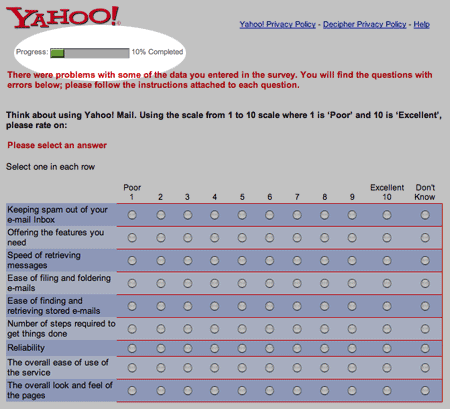
So what’s wrong here? In order of importance:
- This is not even a survey about Yahoo Finance. It’s about Yahoo Mail.
- I count 9 questions on the screen and I’m only “10% complete”. I extrapolate from this that in order to complete the survey, I will need to answer ALMOST 100 QUESTIONS. This was the point that they lost me… and I *wanted* to fill out a survey.
- Each question has 10 choices. Is that *really* necessary? How about just “poor, neutral, excellent”? The amount of brainpower required to make such granular judgements is prohibitive in surveys like this.
- Once I decided that I didn’t want to fill out every single item on this survey and maybe just check if there was anything related to Yahoo Finance or the password-prompting thing, I clicked “Continue” to quickly skip to other screens. Sorry, no go. It’s all or nothing. Unless I’m willing to fill out every single radio button in this survey (in order!) I cannot even participate. I want to give Yahoo *some* data and they won’t take it unless I give them *all* data.
This is really bad practice, Yahoo. You have presented a survey that will not only receive much less participation than it should, but the data you *do* get will not even be representative of your user base. The only people who will fill this out are people who are extremely patient, extremely concerned about you, and in possession of a lot of free time. Is that really representative of your user base? Cut this thing down to one page and you’ll learn a lot more.
* On a humorous note, I just noticed two links in the upper right side of the screen: “Yahoo Privacy Policy” and “Decipher Privacy Policy”. I thought it was an attempt by Yahoo to be funny about how long and indecipherable their privacy policy is. Nope. Turns out the company who provides the survey goes by the name of “Decipher”. Ha!
Back from Syndicate and IMC 2006
Two conferences, two vastly different crowds of people, and only two people I knew at both events combined. That’s the one sentence summary of my five days in New York and Las Vegas last week. It was a fun week, and definitely a personal highlight sitting next to Roger Black on stage, but I couldn’t help but notice how dissimilar the situations of the attendees at both conferences were.
On the one hand, there was the Syndicate crowd — a group of people pretty well ahead of the curve on the technology side, but well behind on the business side. The types of people who preach giving up all control of your content and basically letting any business issues just work themselves out. “RSS” was mentioned hundreds of times. “Web 2.0” almost as often. The focus here seemed to be — not surprisingly — on syndication, but there was very little talk about business models, products, creativity, or really anything outside the scope of “delivering information”. There were a few interesting exceptions which rounded the event out a bit, but that was the gist of things.
On the other hand, there was the Interactive Media Conference crowd — a group of people squarely on the other side of the equation. People working at traditionally profitable businesses (mainly newspapers) whose companies are quite obviously threatened by many of the concepts discussed at the Syndicate conference as well as plenty of other emerging forces. There were a number of visionaries there doing great things at their respective organizations, but this conference was all about established media.
So what was the more fun conference? For me it was the second, by quite a bit. For all the time I spend researching, using, and sometimes creating technology, I just don’t like talking or hearing about it when it’s not coupled with interesting, tangible products. I don’t want to hear about RSS. I want to hear about a product that is 1000 times better because of RSS. I don’t want to hear about Web 2.0. I want to hear about a service that, via its Web 2.0 approach to things, improves the lives of thousands of people.
I felt the Interactive Media Conference Crowd was much more interested how to use technology to improve their product, whereas the Syndicate crowd was looking for products with which to use their technology. Two honorable quests I suppose, but hey, how long can you really talk about RSS? For me, it’s about an hour until I eventually fall asleep.
Both talks went very well. Everyone on the Syndicate panel was mostly of like mind until we closed the session with a cursory discussion about full-text vs. excerpts in feeds. I’m an excerpt guy for now until certain rights, monetization, and content theft issues work themselves out, and someone else on the panel was for full-text. Judging from the reaction of the crowd afterwards, the world seems equally undecided. The full-text vs. excerpt debate is one that deserves its own blog entry — and will probably get one — but for now, my opinion is that people should do whatever makes the most business sense for them. At least one person at the conference mistakenly thought I meant that full-text feeds were evil and no one should use them. I can only attribute that to a bit of what I will now call The Jason Fried Effect (anybody want to do a Wikipedia entry on that?) — that is, when confident words are mistaken for unconditional advice.
The Interactive Media Conference panel was more interesting and touched on subjects ranging from typography on the web, to redesign strategies, to new distribution methods, to branding, to inverted pyramids. I was thrilled that Roger loved Newsvine and so did many others at the conference. That day I also learned that Forbes Magazine gave Newsvine their “Best of the Web” designation for user generated news sites. I don’t mention every time we get an award or recognition somewhere and I don’t spend any time entering us into competitions, but it’s always gratifying seeing the company get a step closer to the mainstream.
All in all, it was an interesting week, but I’m glad to be back in the office working on Newsvine. We’re launching some great new things in a couple of days.
Welcome To BotSpace
Another day, another MySpace post. I don’t mean to keep picking on the wildly successful social networking site, but just now, I saw a banner ad which really made me wonder what’s going on over there.
Five minutes ago, at the top of my MySpace profile page, I noticed a large ad for a site called “MySpaceBot.com”. The impressive collection of testimonials fading in and out across the bottom of the ad piqued my interest. A screenshot is below:
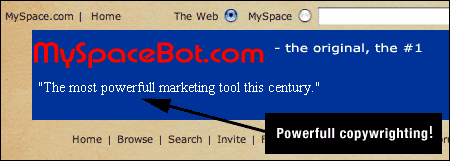
Whoa! I know this century is only six years old so far, but “the most powerfull [sic] marketing tool this century”? I had to have a look. Interestingly, the banner led to a site called “Friendbot.com”. Friendbot sells a product that — get this — specifically evades MySpace’s security procedures and performs all sorts of automated actions around the site. Here’s a sample of what evil Friendbot can do:
- Evades CAPTCHAS put in place by MySpace to curb spam
- Imports entire friend lists from anyone inside of MySpace
- Sends automated friend requests that appear to be human-generated
- All sorts of other evil bottish things
Here’s an interesting line from their FAQ:
Will I be banned from MySpace.com for using this program?
No you will not. But if by some miracle you manage to get banned, do not come blame us.


This whole Friendbot thing was starting to seem weird to me, so I dug a little deeper.
IE7 and Search Defaults: Not a Whineable Offense
I can’t believe the amount of chatter around the web today about Microsoft’s plans to include MSN search as the default search option in IE7. What exactly about this is surprising? And what exactly about it is wrong?
I am the last person on earth to give Redmond free passes for anything but this has been coming for years, and it’s perfectly ok in my book. Why is it ok?
- The more incentive Microsoft has to get IE7 proliferated into the population asap (preferably through auto-update), the better off the web development world, and by extension, the internet-using population will be.
- If Google was so concerned about this, why haven’t they used a few hundred million dollars of their war chest over the past year or two to help turbocharge the relatively blasé Firefox adoption rates we’ve seen lately? Google has always said they don’t need to make their own web browser, and they are right… but they *do* perhaps need to make someone else’s irrelevant.
- This is not much different than Microsoft’s decision to make everyone’s default start page “MSN.com” when it released Internet Explorer. If I’m not mistaken, out of all the things Microsoft was judged to be guilty of by the DOJ, that wasn’t one of them. I could be wrong about this, but I just don’t remember that being part of the verdict.
- OEMs can change the search default to whatever provider they’d like, and after that, consumers can change it again themselves (although many, of course never do… see: MSN.com’s 1 trillion daily users).
I suppose I understand why Google is throwing such a huge stink about this, because hey, why not? But in the end, I don’t think it’s anything that should be subject to government intervention. We all hate it when one company dominates any particular sector of business, and in the technology world, that company has usually been Microsoft. But it’s entirely possible that that company is now Google, and although we all love them, competition is almost always a good thing.
MySpace: Unstoppable Force or Unnecessary Click Factory?
So I just read the big article about MySpace in today’s New York Times and it got me thinking a lot about growth, monetization, and user experience. People always talk so much about how many pages MySpace serves up and how that represents such dramatic growth.
After playing with the thing for a few weeks and writing a hugely ridiculous article on customizing it, one thing has really stuck out to me: there are a tremendous amount of extraneous page views being generated at that place. It’s a factory of unnecessary clicks. And so when one would view MySpace’s current page view trends on Alexa, one would see this:

Here’s a sobering thought: If the operators of MySpace cleaned up the site and followed modern interface and web application principles tomorrow, here’s what the graph would look like:

(Editor’s Note: I originally fat-fingered the first graph above when uploading it and used the Reach graph by mistake. Fixed. Both graphs show the exact same curve, however. Thanks to Owen Thomas of Business 2.0 for the heads-up.)
Read more…
I Steal Television Shows Because I Have To
 This morning, via Cory Bergman and Lost Remote, comes word that Charter Communications has been sending letters to their customers telling them to stop BitTorrenting HBO shows. Essentially, HBO has been watching torrents and trackers looking for the IP addresses of everyone who is “sharing” one of their shows. Upon identifying an IP address and associating it with a filename like “The.Sopranos.S06E02.HDTV”, HBO will send a letter to the ISP who owns that IP address urging them to revoke that customer’s internet access altogether.
First let me say that I believe in HBO’s right to stop their shows from being shared online. Sorry, but I do. The Sopranos is property of HBO and the only license they grant is for you to either a) watch it on HBO, or b) buy/rent the DVDs. HBO is a premium channel so you pay for the right to watch their stuff and you don’t have to deal with commercials. Fair enough, as far as I’m concerned.
Notwithstanding the above paragraph, it’s interesting to note the steps that HBO must take in order for them to actually have these letters sent. They must first equip themselves with the same BitTorrent software that they seem to be fighting against. Then, they must seek out these Torrents, and I believe actually participate in them in order to verify that a file named “The.Sopranos.S06E02.HDTV” is actually the Sopranos and not a one-hour home movie from god knows who. So it’s clear they have to actually download the file. This would seem to be illegal, but I guess they’d let themselves off since they own the content. But with BitTorrent, when you download, you also upload, so not only are they sucking the file down to their machines, but they are also willingly distributing it to others. I know the goal is to just catch thieves, but isn’t this very entrapment-like? I don’t want to get any deeper into the legal aspect of this because a) I’m not a lawyer, and b) it’s probably possible to download from BitTorrent without uploading, but I just thought it was interesting.
Throwing HBO aside for a moment though, I’d like to publicly admit to my ISP (Qwest) and the rest of the world that I, too, steal television shows.
My cable provider is Comcast. I pay for a premium package including HDTV, an HD-PVR, way too many channels, and HBO. I watch stuff live whenever I can, and I don’t mind commercials. I take that back. I mind the Applebee’s commercial with the damn Gilligan’s Island theme song parody. I HATE that thing.
Occasionally, however, I am doing other things, such as working, when one of my favorite shows is on. In the past, I have either set my VCR to record these shows or set up the old Season’s Pass on the DirecTivo to do the trick. But since Comcast bugged me time after time to switch away from my DirecTV service and onto their HD Cable Service with PVR (that’s Painfully Volatile Recorder), I now have to rely on the technology Comcast has chosen for me in order to catch Survivor and 24.
So without getting into the ugly specifics of the Comcastorolasoft PVR (I’ve done that three times on this blog already), let me just say that this recorder obeys orders about as reliably as Internet Explorer renders CSS. That is to say, sporadically, sloppily, and at times, without reason. Not only have I missed entire shows but I also missed the final minutes of two extremely important basketball games even though I set the box to record well over the allotted time of the show.
So when you’re in the middle of a season of 24 and you miss an episode because your cable box was too busy, ummmmm, displaying the time, what do you do? What CAN you do? There are no repeats. There are no free downloads for cable subscribers. The only thing you can do is hop on Azureus and BitTorrent yourself the episode you missed.
And that’s what I do. About two or three times a month.
It’s not clear who is at fault here on the technology side so it’s hard to point fingers. It’s either Comcast (the providers of the service), Motorola (the makers of the PVR), or Microsoft (the engineers of the PVR’s operating system). Those who know me would guess I’d be most likely to blame Microsoft — and I do — but the only company I’m willing to give a bit of a free pass to here is Motorola. It’s not clear they have any control over what’s going on. Comcast, on the other hand, does. Even if the cause of this PVR’s instability is the Microsoft OS, they are the ones who approved and continue to approve its use in the Seattle metro area (other areas around the country do not use the Microsoft OS).
So who are the losers in this whole equation?
- TV Advertisers: When I download a show, there are no commercials for me to watch.
- TV Stations: When I download a show, I am not tuned to a TV station, so theoretically, if Neilson homes did this, ratings would go down.
- Everyone involved in creating TV shows: By bypassing the economics of television distribution and monetization, I am decreasing the amount of money in the system and therefore the incentive to create great shows.
- Qwest: Because I am downloading 350 megabyte shows, I am sucking up unnecessary bandwidth from my ISP.
- Me: I hate downloading shows. I have to watch them on my laptop instead of the HDTV and there is often a few day delay in actually procuring the program.
And who are the winners?
The only person I can think of is perhaps the person who doesn’t pay for TV at all and is receiving tons of shows by virtue of this growing TV-sharing environment on the internet.
So what’s the solution to this whole problem? Well, I have a few obvious suggestions:
- Cable companies, please fix your PVRs already. Buy Tivo if you have to. In three years using a DirecTivo, I never missed a show.
- Whether you’re a cable or satellite company, offer as many of your shows on-demand as possible. Comcast offers most HBO shows on demand, so even if I miss an episode, I can view it whenever I want. In other words, Comcast and HBO have seen to it that if you pay for HBO, there is no reason you should ever need to download an HBO show illegally. Good move.
- Continue the policy of prohibiting commercial-free, illegal copies of shows to be distributed over P2P networks but change the game entirely by offering perhaps both pay-per-download and ad-supported versions of shows online.
I have no indication that suggestion number one will happen anytime soon, but numbers two and three are already at various points of development. I can only hope that when these new models mature, the economic model for television will remain viable.
Until then though, I will keep stealing TV as long as technology forces me to.